Independent Concept
Altamere Agent GatewayWhen your AI agent calls your financial company
Altamere Financial, its customer, and every account, rate and disclosure shown here are fictional.
01 / Context
The Challenge
Personal AI agents are starting to act for people. But if you ask one to update your address or move money at a financial company today, its only option is to sign in as you and click through the website.
That’s bad for everyone. The company can’t tell you from the agent, you can’t limit what it does, and a stolen session looks exactly the same. I wanted to design a better arrangement for a fictional financial services company, across five real requests: a premium payment, an address change, a disbursement, a loan and a withdrawal.
02 / Judgment
What I questioned
The model I landed on fits in one line: you delegate, the agent asks, and the company decides.
Assumption
An agent should use the website like a person.
An agent that signs in as you is indistinguishable from someone who stole your session. Here the agent acts as itself, carrying a mandate you granted, never your password.
Assumption
Simple requests are safe requests.
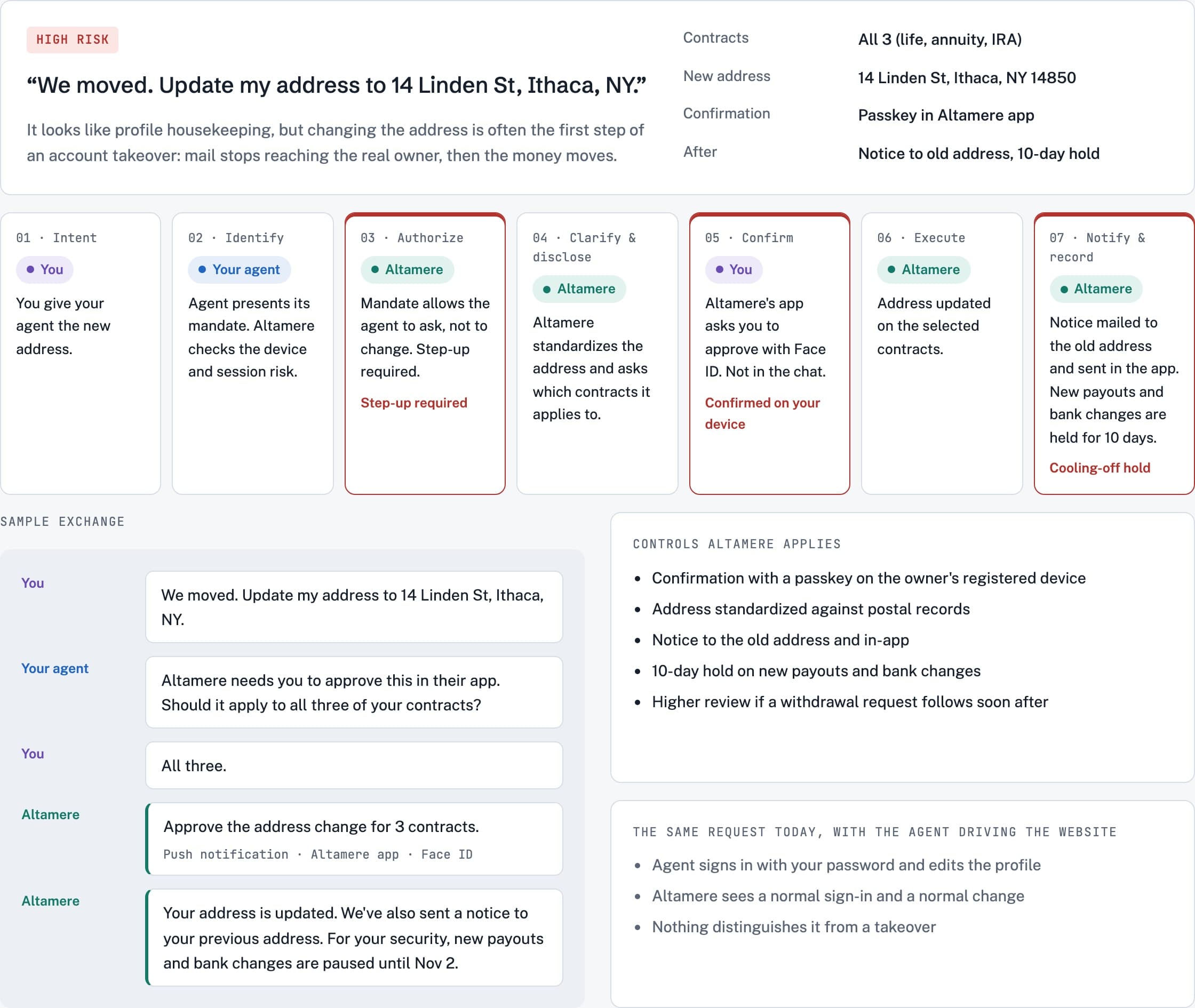
An address change looks like housekeeping, but it's often the first step of an account takeover. It gets more friction than a premium payment, and it pauses money out for 10 days.
Assumption
Saying yes in the chat is consent.
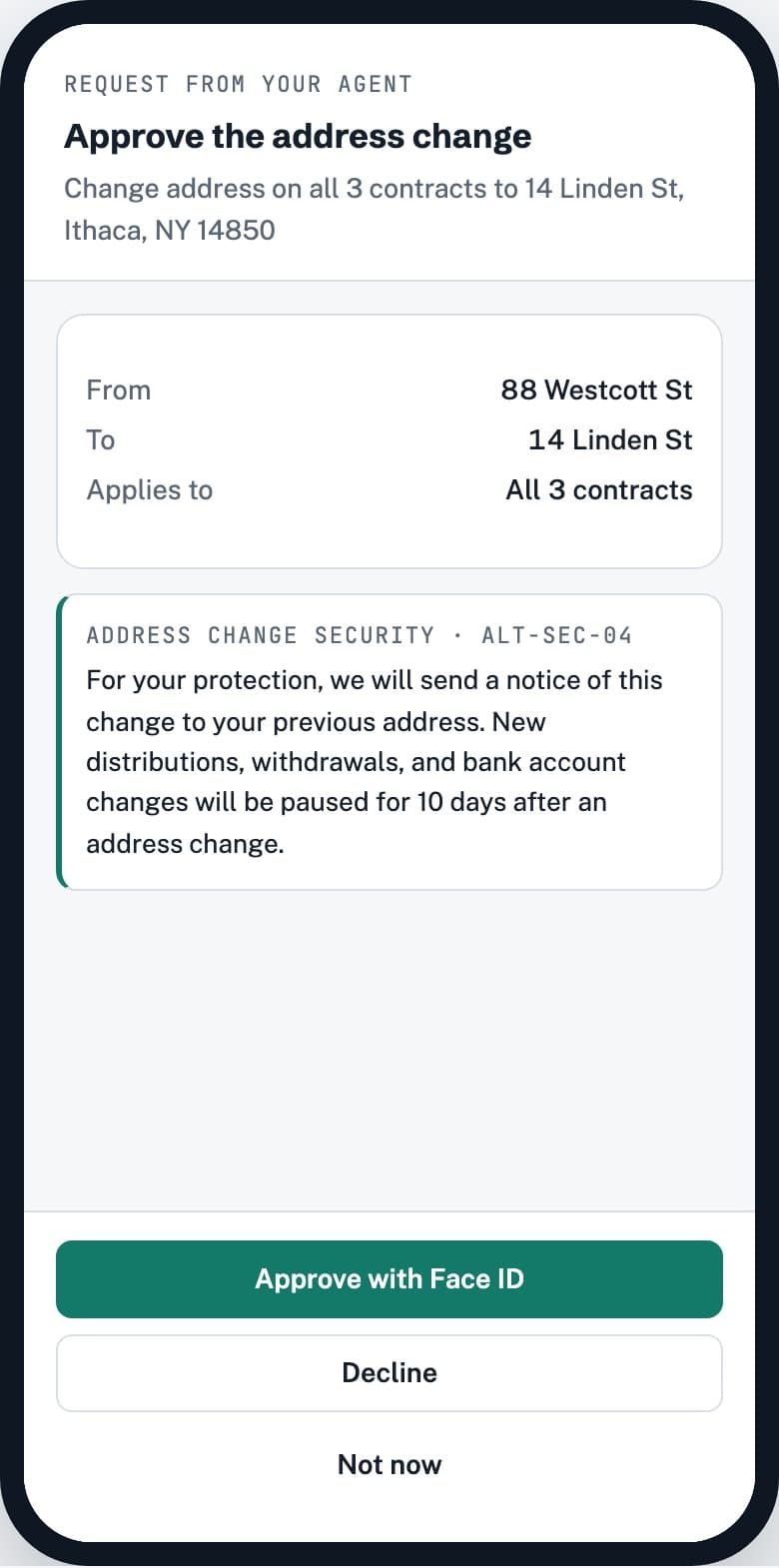
Anything risky is confirmed by the owner on their own device, in the company's app. The agent can ask. It can't approve its own requests.
Assumption
The agent can summarize the fine print.
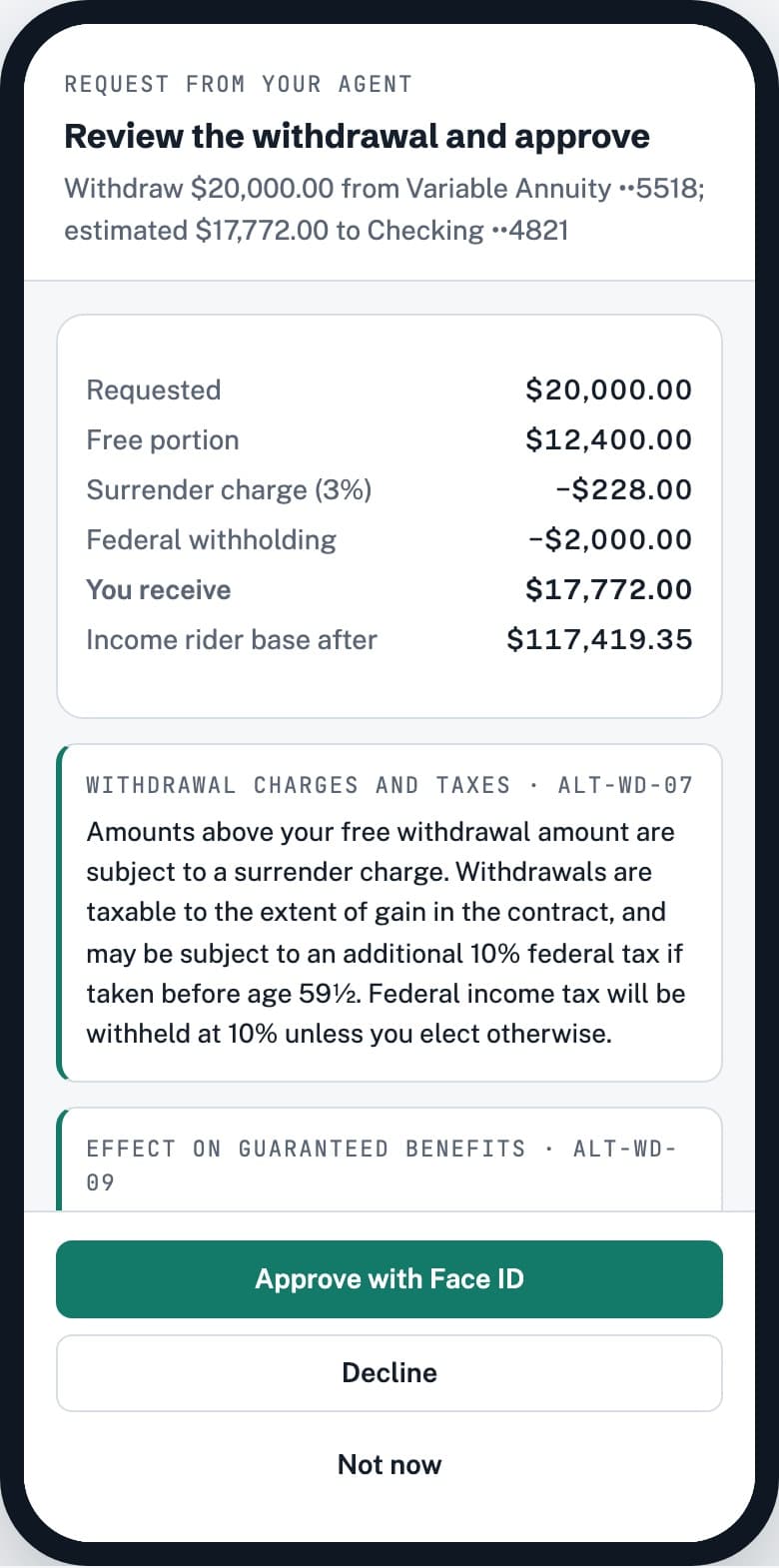
Disclosures travel from the company word for word, and the owner sees them again before approving. The agent can explain them, but it can't paraphrase them away.
03 / Experience map
Five requests, one journey
I started with a map rather than screens. Every request moves through the same seven stages: intent, identify, authorize, clarify and disclose, confirm, execute, and notify. What changes is how much friction each stage adds, and that depends on risk.
- Premium paymentRisk: LowCompletes on its own, within the mandate's monthly cap
- Loan requestRisk: ElevatedQuote freely; the owner e-signs the loan agreement
- Address changeRisk: HighOwner approves; notice to the old address; 10-day pause on money out
- DisbursementRisk: HighOwner approves and chooses tax withholding
- WithdrawalRisk: HighOwner sees the net amount, charges and rider effect; call-back over $25,000
04 / The Work
A gateway, a phone, and an agent
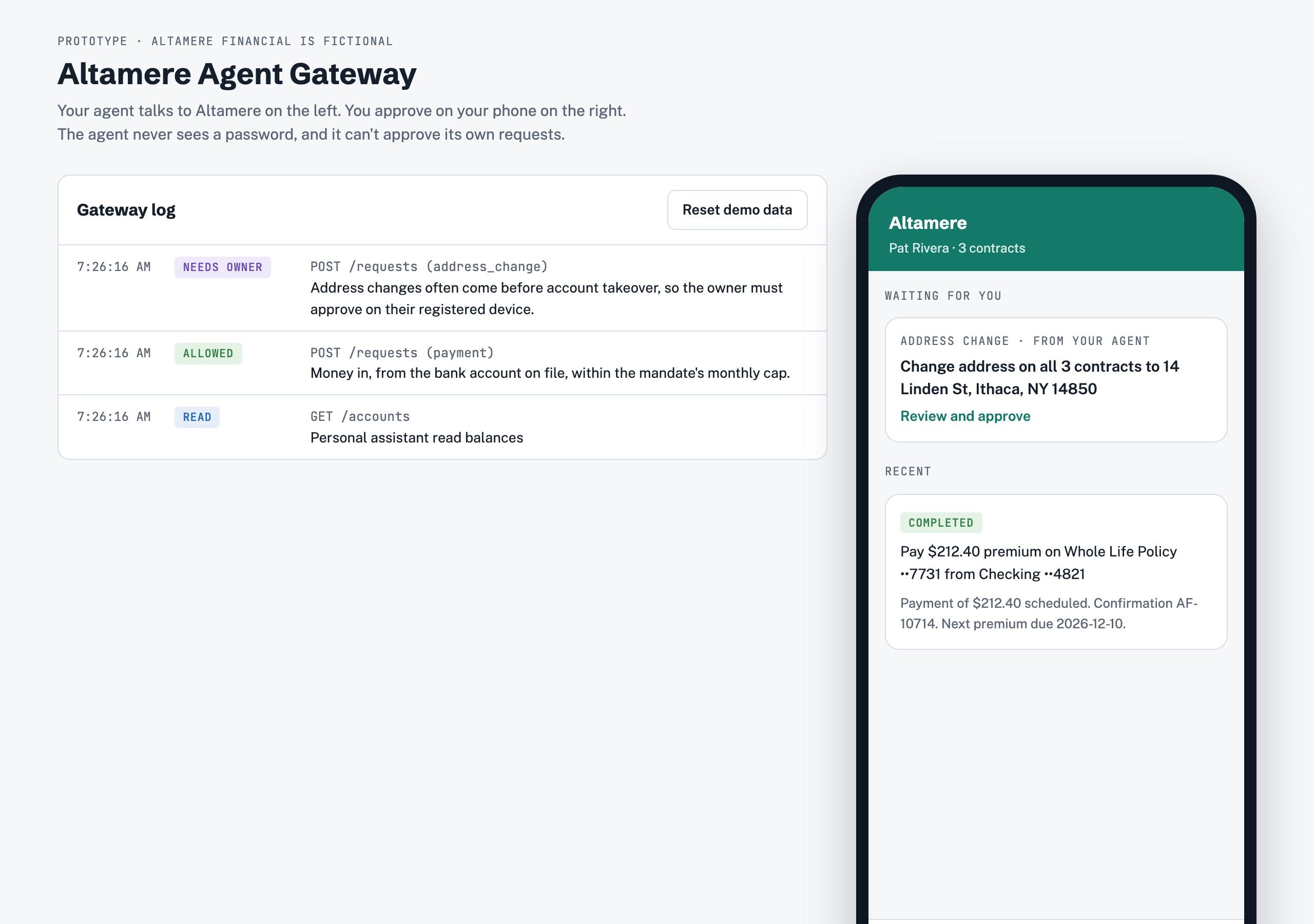
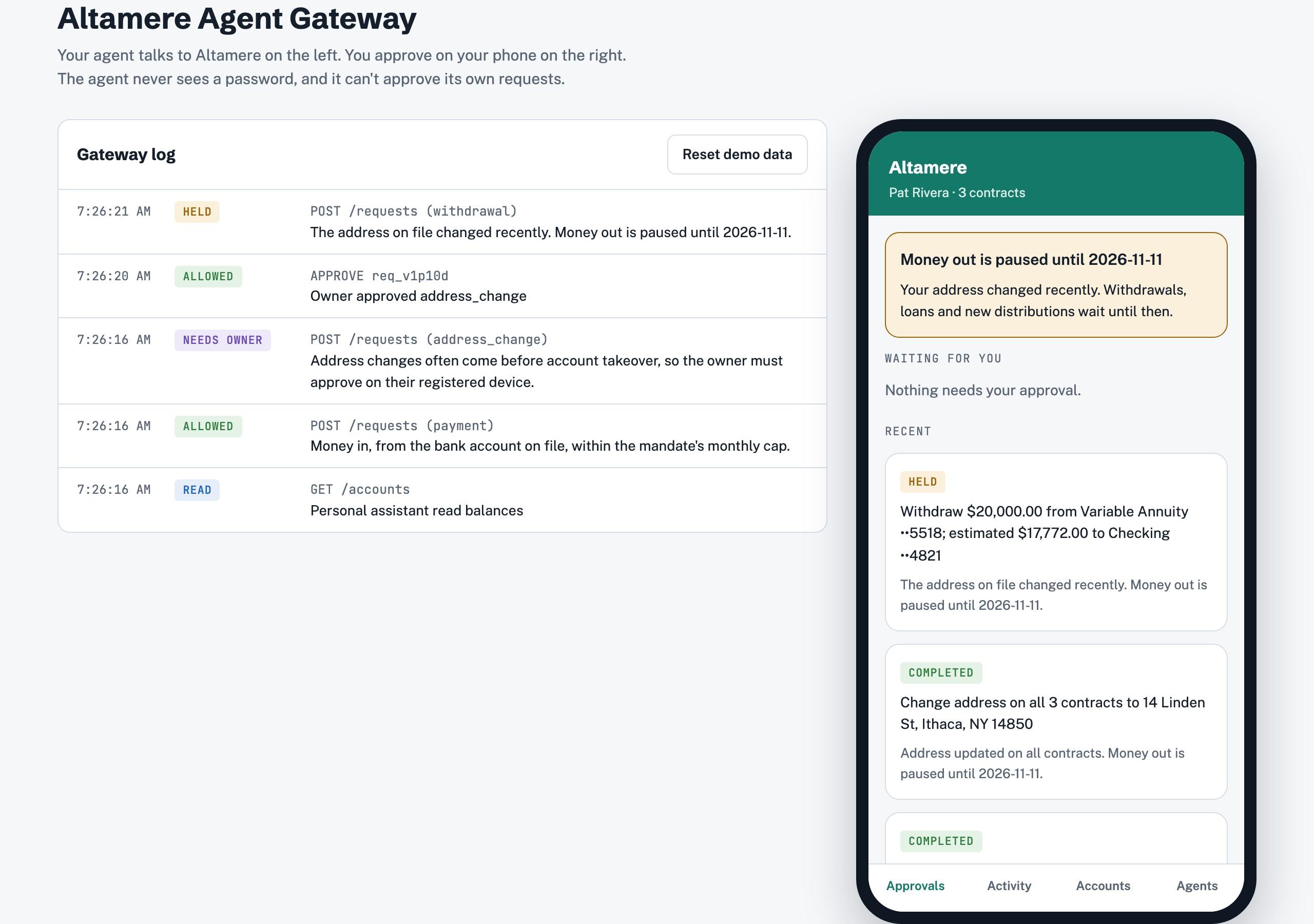
The agent’s calls and the gateway’s decisions on the left. The owner’s phone on the right.
05 / Implementation
Under the hood
The rules engine is a pure function. It reads the account and the mandate and returns one of four outcomes: complete it, send it to the owner, hold it for review, or refuse it, always with a reason. Approvals are checked again at the moment the owner taps, because things can change after the agent asks.
Agents connect through the Model Context Protocol. Claude, or any MCP client, gets nine tools for reading accounts, getting quotes and making requests, authorized by a mandate token. Every visitor gets their own sandbox and token, so anyone can connect an agent and try it without touching anyone else’s demo.
Next.js, React, TypeScript, Postgres and the MCP TypeScript SDK, with tests covering each rule, including the takeover pattern and sandbox isolation.
06 / Outcome
What’s real, and what’s next
Working
- All five requests, end to end
- Mandates, risk rules and holds
- Owner approvals with disclosures word for word
- An activity log and one-tap revoke
- A real MCP connection for AI agents
Simulated or not built
- Passkeys and Face ID (simulated)
- Verifying which agent is calling
- Signed mandates
- New bank accounts and beneficiary changes
More work
See other products I’ve designed and built.